
Liquidity: liquidity pools, stop runs and sweeps
The Liquidity page maps where stop orders are likely to cluster on a market: pools of equal highs and lows above and below price, the sweeps that have already taken them, and key reference levels such as the previous day's high and low.
What are liquidity pools?
When several swing highs form at almost the same price, many traders place their stops just above them, and breakout traders place buy orders there. The same happens below equal lows. These clusters of orders are called liquidity pools. Above price they are buy-side liquidity (BSL), because the stops of short sellers are buy orders; below price they are sell-side liquidity (SSL).
Large participants need liquidity to fill big orders, so price is often drawn to these pools. A sweep happens when price trades through a pool, triggers the stops, and then closes back on the other side. A sweep followed by a reversal is often called a stop hunt.
What it shows
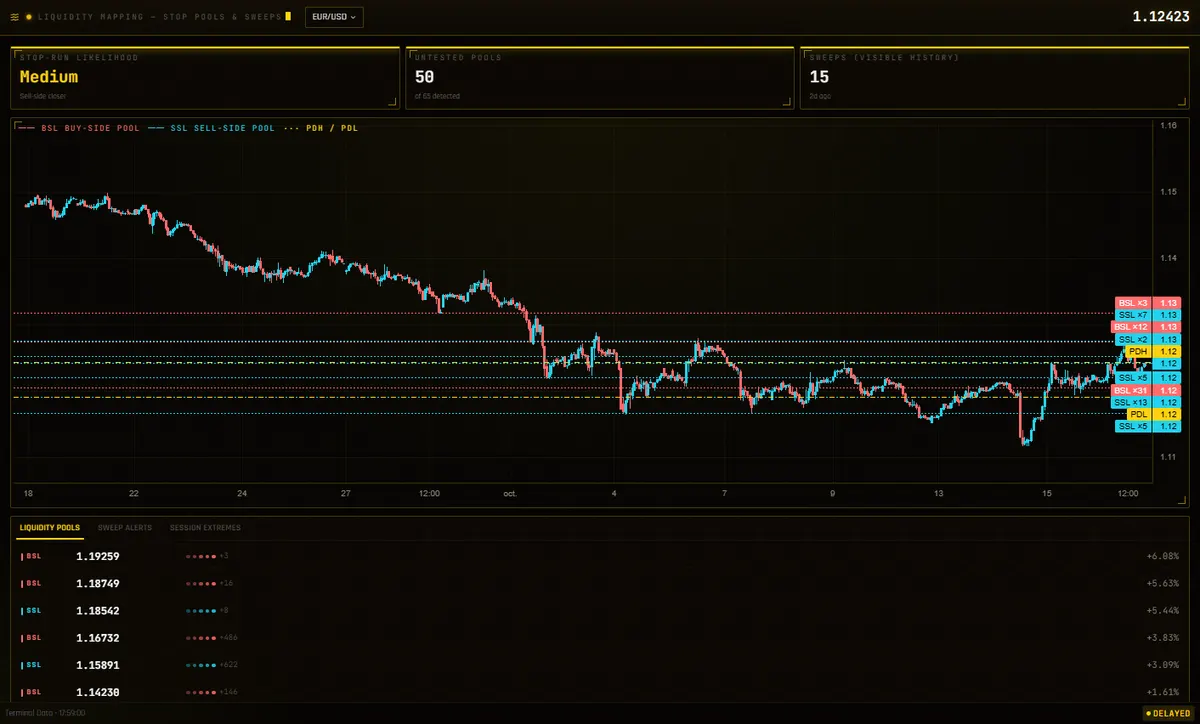
The analysis runs on hourly candles. Three tiles sit at the top: Stop-run likelihood, Untested pools (pools not yet taken, out of all those detected) and Sweeps (visible history) with the time of the latest one.
The chart draws the eight untested pools closest to the current price as dashed lines, labelled BSL or SSL with the number of touches (for example BSL ×3), and the previous day's high and low as PDH and PDL. Below the chart, three tabs give the detail:
- Liquidity Pools: the untested pools, with their side, price, number of touches and distance from the current price.
- Sweep Alerts: the latest sweeps, with the side, the level taken, the strength of the reversal (Strong, Moderate or Weak) and how long ago it happened.
- Session Extremes: the high and low of the previous day, the previous week and today's Sydney, Asian (Tokyo), London and New York sessions.
How to read it
Pools are found from swing points and grouped when their prices are within a very small tolerance of each other. The more touches a pool has, the more obvious it is to other traders and the more orders it is likely to hold.
Stop-run likelihood compares the distance to the nearest pool above with the distance to the nearest pool below. When one side is much closer than the other, the reading is High and the tile tells you which side is closer (Buy-side closer or Sell-side closer); when both are at similar distances it is Low.
For a sweep, the reversal strength measures how much of the move beyond the level was given back by the close: more than 70% is Strong, more than 40% Moderate, less is Weak. A strong sweep of a well-touched pool is the classic stop hunt pattern.
A pool is not a level that must hold. Once swept, it has done its job; watch what price does after the sweep rather than the level itself.
How to use it in your trading
An educational example: EUR/USD is in a downtrend and the page shows Stop-run likelihood at Medium, sell-side closer, with an SSL ×5 pool just below the previous day's low. You avoid placing your own stop at that obvious level. If price then trades through the pool and closes back above it, the Sweep Alerts tab shows a sell-side sweep with its reversal strength, which can be a sign that the sellers' fuel was used up. You would still want confirmation from the trend and momentum on the Technical Heatmap before acting.
The same logic helps with stop placement: putting a stop a little beyond a pool, rather than exactly at it, avoids being part of the liquidity that gets taken.
Filters and settings
Choose the market with the symbol selector at the top, which includes a search box; any instrument tracked by the terminal can be analysed. The last price is shown on the right of the header. The data refreshes every 5 minutes. To track session times live, see Market Hours.
Questions
What is a liquidity sweep?
A sweep happens when price trades beyond a pool of equal highs or lows, triggering the stops resting there, and then closes back on the other side of the level.
What do BSL and SSL mean?
BSL is buy-side liquidity, the stops and buy orders above equal highs. SSL is sell-side liquidity, the stops and sell orders below equal lows.
Which timeframe does the Liquidity page use?
Pools, sweeps and session extremes are computed from hourly candles.
Related pages
Try it in the terminal
Every tool described here is included in the subscription, with a three-day free trial.
Start the free trialTrade Sider is an analysis tool and does not provide investment advice. Trading involves a risk of capital loss.