
Bank Research
The Bank Research page gathers the research the banks publish themselves: daily macro and FX notes in PDF, news from the banks' own websites, their latest reported figures and their regulatory filings. Everything opens inside the terminal.
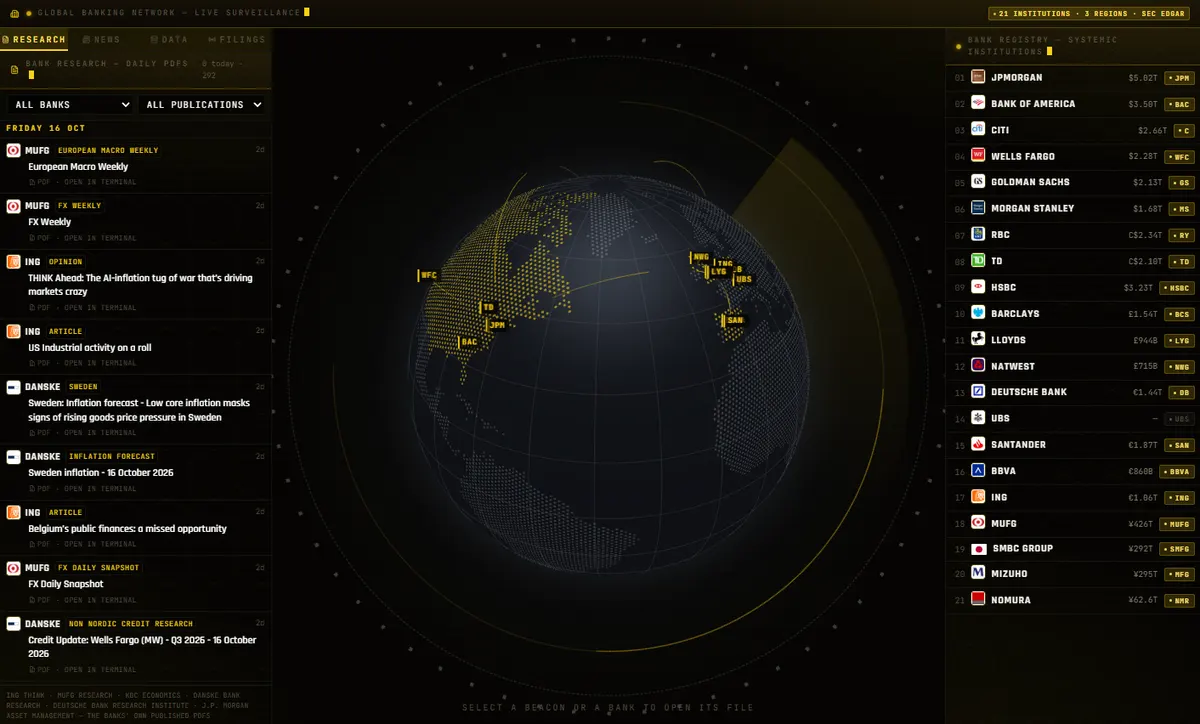
What it shows
The page has three areas. On the left, a column with four tabs: Research, News, Data and Filings. In the center, a globe showing the 21 banks covered across three regions (Americas, Europe, Asia-Pacific). On the right, a registry listing each bank with its total assets. Clicking a bank on the globe or in the registry opens its file.
- Research: the research notes published as PDFs by ING Think, MUFG Research, KBC Economics, Danske Bank Research, Deutsche Bank Research Institute and J.P. Morgan Asset Management. Each entry shows the bank, the publication series (for example FX Weekly or an inflation forecast), the title and how long ago it was published. Click it to read the PDF in the terminal.
- News: news published by the banks on their own websites, with a category: Markets & economy, Rates, FX, Commodities, Results, Corporate or Community.
- Data: each bank's latest reported figures, as tagged in its SEC filings: net income, earnings per share, assets, equity, deposits and loans, in the bank's own reporting currency. Click a bank to open its report.
- Filings: a wire of the banks' news and regulatory reports, filterable by
All,NewsorReports.
The bank file
Each bank's file has four tabs: Figures (key figures with charts of total assets and net income by fiscal year), Reports (its published results and filings), News and Stock (a daily chart of the bank's share price). The figures come from SEC EDGAR filings.
How to read bank research
Bank research notes are written by economists and strategists for the bank's clients. They usually cover the outlook for growth, inflation and central bank policy, previews of upcoming data, and views on currencies and rates. They are opinions, not facts: their value lies in the reasoning, in what the bank expects and why.
Read them for three things: the base case (what the bank expects, for example a rate cut in December), the arguments (which data would confirm or contradict that view), and the risks the authors identify. Comparing several banks on the same subject shows whether the market view is unanimous or divided. When views diverge strongly, the next data release tends to matter more.
How to use it in your trading
Example: Swedish inflation is due tomorrow. Filter the Research tab on Danske Bank and look for its inflation forecast note. The note gives the bank's expected figure and explains what drives it. Then open the Economic Calendar, where the bank's forecast also appears in the forecast range of the release. If the figure comes out far from the bank's call, you understand which assumption was wrong.
Before a central bank meeting, weekly notes such as FX or macro weeklies summarise what each bank expects. Compare them with the probabilities on the Rates page: when the banks and the market disagree, the meeting carries more potential for surprise.
Filters and settings
In the Research tab, the All banks and All publications menus filter the list by bank and by publication series. Your choice is saved for your next visit. The header shows how many notes were published today and how many are in the list. Notes are grouped by day.
For a summary of each bank's current calls by asset, see the Bank Positioning page, which reads the same published research.
Questions
Which banks' research is available?
The research feed includes the published PDFs of ING Think, MUFG Research, KBC Economics, Danske Bank Research, Deutsche Bank Research Institute and J.P. Morgan Asset Management. The registry covers 21 global banks for news, figures and filings.
Are bank research notes trading recommendations?
No. They are the banks' own published views and analysis. They are useful to understand the reasoning of professional economists, but they are not recommendations from Trade Sider.
Related pages
Try it in the terminal
Every tool described here is included in the subscription, with a three-day free trial.
Start the free trialTrade Sider is an analysis tool and does not provide investment advice. Trading involves a risk of capital loss.